When Comprehensive Data Questions Established Breeding Theories
In thoroughbred breeding, certain pedigree patterns achieve near-mythical status, championed by respected figures and seemingly validated by high-profile success stories. One such pattern – inbreeding to the broodmare sire of the sire – has recently been subjected to unprecedented statistical scrutiny, with surprising results that challenge conventional wisdom.
The Theory and Its Champions
In a recent article, respected pedigree expert Sid Fernando highlighted the concept of “inbreeding to the broodmare sire of the sire” as a potentially valuable breeding pattern. Fernando presented several notable examples:
- Hall of Fame: A Gun Runner colt inbred 3×2 to Giant’s Causeway (Gun Runner’s broodmare sire is Giant’s Causeway, and Hall of Fame’s dam’s sire is also Giant’s Causeway)
- West Coast Belle: A Tapit filly inbred 3×3 to Unbridled (Tapit’s broodmare sire is Unbridled, and West Coast Belle’s dam is by Unbridled’s Song, a son of Unbridled)
- Quiet American: A colt inbred 3×2 to Dr. Fager (the broodmare sire of Fappiano)
Fernando attributes the concept to legendary pedigree authority Leon Rasmussen and notes how the pattern was strategically applied by breeding icons like John Nerud. These selective examples of successful individuals offer compelling anecdotal evidence – but what happens when we examine the pattern across the entire thoroughbred population?
Historical Context: The Tesio Legacy
The search for meaningful pedigree patterns has a rich history in thoroughbred breeding. Perhaps no one exemplifies this better than Federico Tesio, often called “the only genius ever to operate in the breeding world.” Tesio’s extraordinary ability to identify deep linebreeding patterns without the aid of computers led to unprecedented success – 22 Derby winners, 11 Oaks, 18 St Legers, and 22 Gran Premio di Milano’s from his Dormello stud.
Tesio wrote in his book: “For 50 years I have carefully studied the pedigrees of over a thousand horses that have won the great races, examining these pedigrees to the 7th and occasionally to the 12th generation.” He understood that linebreeding back to 8 and 9 generations could amplify an ancestor’s influence, creating powerful genetic combinations.
While Tesio’s genius allowed him to see patterns that others couldn’t, modern data science now enables us to test breeding theories across millions of horses, potentially uncovering patterns that even Tesio might have missed. This brings us to our analysis of the broodmare sire pattern.
The Largest Analysis Ever Conducted
Our research team conducted what is likely the most comprehensive pedigree analysis in racing history, examining 1,117,865 thoroughbreds foaled between 2000-2021 across the Northern Hemisphere, Australia, and New Zealand. Within this massive dataset, we identified 42,479 horses (3.8%) that exhibited the “broodmare feature” pattern – where the broodmare sire is the dominant ancestor of the sire.
We compared the performance of these horses to the overall population using a rigorous classification system:
- Class 0: Group/Graded 1, 2, and 3 stakes winners (G1W, G2W, G3W)
- Class 1: Group/Graded 1 placed (G1PL), Group/Graded 2 placed (G2PL), Listed winners (LW), Group/Graded 3 placed (G3PL)
- Class 2: Listed placed (LPL), Stakes winners (SW), Stakes placed (SPL)
- Class 3: Winners (WNR), Placed (PL), Unplaced (UPL), Unraced (UNR)
What the Data Revealed
The results were definitive and surprising:
For the overall population:
- Class 0 (Group/Graded stakes winners): 1.22%
- Class 1 (Listed winners and Group/Graded stakes placed): 2.08%
- Class 2: 2.84%
- Class 3: 93.86%
For horses where the dominant ancestor is the sire’s damsire:
- Class 0: 1.04%
- Class 1: 2.02%
- Class 2: 2.89%
- Class 3: 94.05%
Contrary to the theory, horses with this inbreeding pattern actually produce a smaller percentage of elite performers in the top classes compared to the overall population. There is approximately a 14.8% relative decrease in the likelihood of producing a Group/Graded stakes winner when employing this pattern (from 1.22% to 1.04%).
Only about 42,479 horses (3.8% of our dataset) exhibited this pattern, and when they did, they were slightly less likely to reach the highest levels of racing success.
Machine Learning Confirmation
Our analysis goes beyond simple distribution comparisons. Using advanced machine learning techniques, we examined the SHAP values (SHapley Additive exPlanations) for the “dominant ancestor broodmare” feature in our predictive model.
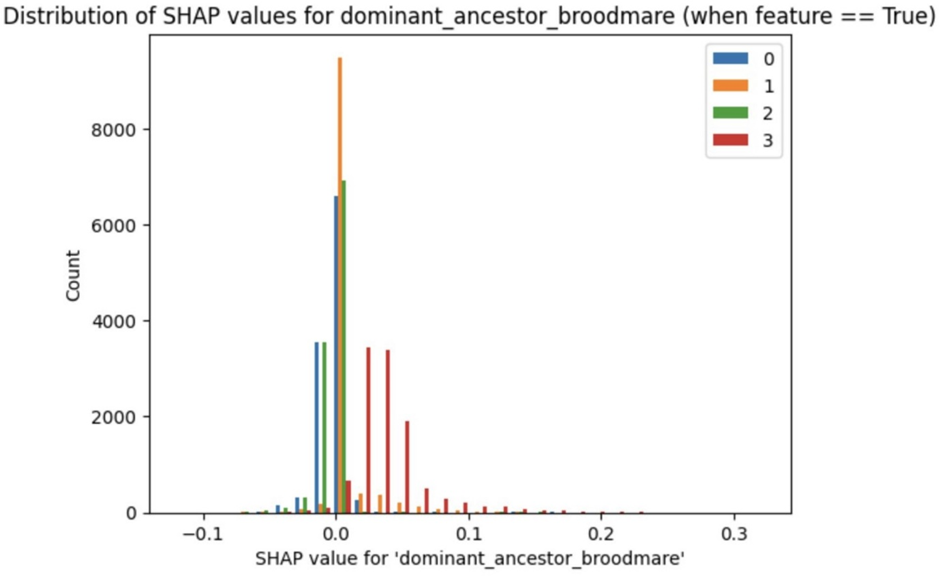
The SHAP analysis reveals that when this feature is present (feature == True), it predominantly generates neutral to slightly negative impact on performance predictions. The distribution shows that for higher performance classes (0, 1, and 2), the SHAP values cluster tightly around zero with a slight negative tendency, while for Class 3 horses, there’s a wider distribution of positive SHAP values.
This visualization confirms our statistical findings – the broodmare sire pattern doesn’t provide the positive impact on elite performance that traditional breeding theory suggests. If anything, the pattern slightly pushes predictions toward lower performance classes.
Visual Representation of the Pattern
To better understand the pattern we’re analysing, consider the following directed acyclic graph (DAG) representation:
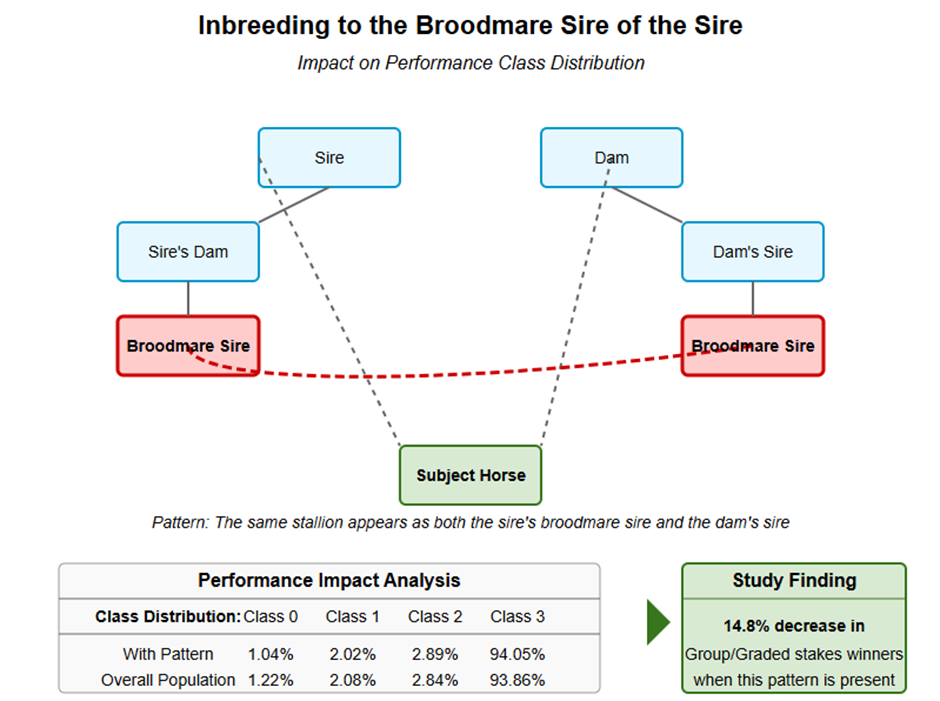
This visualization illustrates how the same stallion appears as both the sire’s broodmare sire and the dam’s sire in this particular breeding pattern. The performance impact is clearly shown: a 14.8% decrease in Group/Graded stakes winners when this pattern is present in a pedigree.
The Power of Comprehensive Analysis
The scale of evidence here is unprecedented. Having analysed 42,479 horses with this specific pattern means our study has evaluated more examples than all pedigree experts in history could have manually analysed combined. Even the legendary Federico Tesio, who meticulously studied “over a thousand horses” throughout his 50-year career, could only examine a fraction of the data now available to us. Traditional breeding theories have never before been tested against datasets of this magnitude.
Fernando’s article cites three successful examples – Hall of Fame, West Coast Belle, and Quiet American. Our analysis identified over 42,000 horses with this pattern, allowing us to see beyond selective examples to the true statistical relationship across an entire breeding population.
Why This Matters
This finding challenges a narrative that persists in the breeding industry based on cherry-picked examples rather than comprehensive analysis. While the highlighted success stories are indeed real, they represent exceptions rather than the rule – rare success stories among more than 42,000 horses with this pattern.
The traditional approach to validating breeding theories suffers from:
- Confirmation bias: Remembering the successes while forgetting the failures
- Selection bias: Highlighting only the high-performing examples
- Lack of comparison: Not measuring against baseline probabilities
- Missing normalization: Failing to account for other variables that contribute to success
A Turning Point in Breeding Analysis
This research represents a potential watershed moment in thoroughbred breeding analysis. By applying robust statistical methods to large datasets, we can now objectively test theories that have influenced breeding decisions for generations.
When theories that have persisted for generations face scrutiny against datasets of this magnitude, we discover that some cherished beliefs about breeding are actually myths perpetuated through selective observation rather than demonstrable patterns.
Implications for Breeders
The evidence suggests that the “inbreeding to the broodmare sire of the sire” pattern, despite its occasional high-profile successes, does not improve the odds of producing elite performers and may slightly decrease those odds.
This doesn’t mean breeders should actively avoid such matings, but they should recognize that:
- Following this pattern provides no statistical advantage
- Such pedigrees should not command premium valuations based solely on this aspect
- The occasional successes are likely due to other factors in the pedigree
- Breeding decisions should be guided by multiple considerations beyond this single pattern
The Path Forward
As the thoroughbred industry gradually embraces more data-driven approaches, we anticipate further challenges to established breeding theories. The challenge will be balancing the art and science of breeding – respecting the generations of knowledge that have shaped the breed while embracing the insights that comprehensive data analysis can provide.
This analysis represents just one application of our broader research program examining the relationship between pedigree patterns and racing performance. By continuing to apply data science to questions previously answered only through selective observation and expert opinion, we hope to contribute to more effective breeding decisions and a deeper understanding of thoroughbred genetics.