
The victory of Australian mare Asfoora in the Group 1 King Charles Stakes at Royal Ascot has once again highlighted the incredible talent of Australian-bred sprinters. Her dominant performance is a testament to the skill and judgment of her trainer, Henry Dwyer, and also serves as a reminder of the complex nature of thoroughbred pedigree analysis.
As we celebrate Asfoora’s triumph and the near miss of Artorius, another member of Flying Artie’s 2018 crop, who finished a close third in the Group 1 Platinum Jubilee Stakes at Royal Ascot in 2022, it’s tempting to attribute their success to specific pedigree patterns or Nicks. However, a comprehensive analysis using Equine Match tools reveals a more nuanced reality. A series of Pedigree Patterns analyses including the one below which focused on the influential sires Northern Dancer, Better Boy, Canny Lad, and Mr. Prospector, all of whom are found in the pedigrees of Asfoora and Artorius, all yielded statistically insignificant results. These findings challenge the prevailing narrative in bloodstock punditry that often seeks to identify simple pedigree affinities as primary determinants of potential.
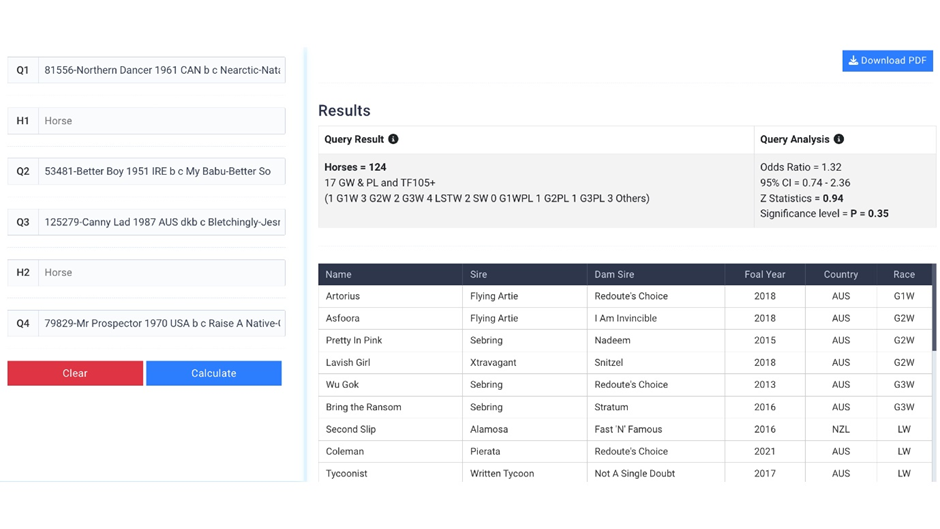
The inconclusive Pedigree Pattern analyses suggest a need to delve even deeper into thoroughbred pedigrees—beyond the 12 generations of the Pedigree Patterns tool—to uncover the complex interplay of ancestral influences shaping the genetic makeup of today’s racehorses. This thesis is supported by a recent study on founder-specific inbreeding depression in Thoroughbred horses (Todd et al., 2018). In the paper, the researchers found that a handful of ancestors accounted for a sizeable portion of the genetic fixation in the modern Thoroughbred population. Interestingly, some of these, such as Herod and Eclipse date back to the early foundations of the breed in the, and it would take a full pedigree analysis stretching back 20-25 generations to measure their influence. This counterintuitive hypothesis underscores the importance of embracing the inherent complexity of thoroughbred genetics and resisting the temptation to oversimplify or rely on convenient narratives.
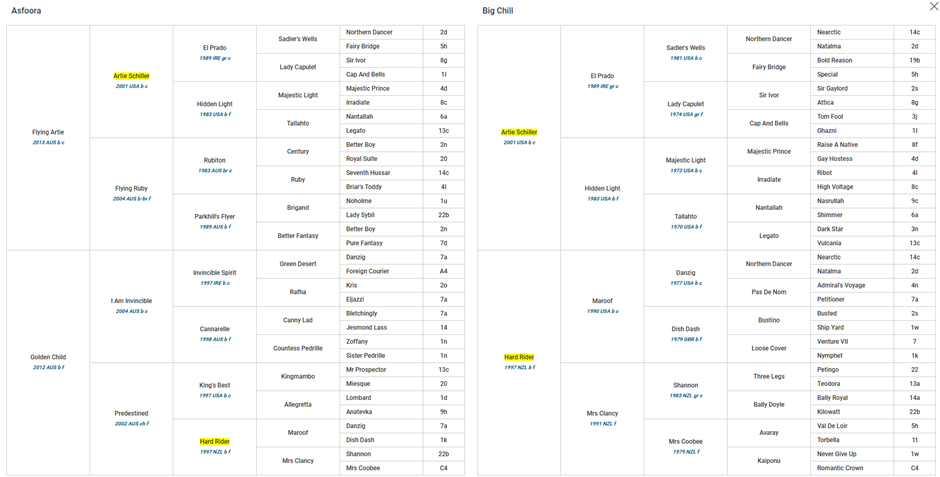
That being said, the spark behind Asfoora’s mating can likely be traced back to 2012, when Big Chill, a mare by Flying Artie’s sire, Artie Schiller, out of Asfoora’s third dam Hard Rider, won the Group 3 Marsh Breeders’ Stakes at Morphettville. Our Common Ancestors tool calculates the Relationship Coefficient between the two at 19.14%, high enough to try the cross again and hope for the best!
Harnessing the power of Equine Match tools like Nicks, Pattern Searches, Pedigree Patterns, and Inbreeding Coefficient reports, analysts and breeders can gain a more comprehensive understanding of a horse’s genetic background, enabling them to investigate and debunk pattern narratives that often dominate bloodstock discussions.
In celebrating Asfoora’s triumph and the ongoing success of Australian-bred sprinters, let us recognize the importance of embracing complexity and nuance in thoroughbred pedigree analysis. Only by challenging conventional wisdom and continually seeking deeper insights can we unlock the full potential of these magnificent animals and breed the champions of tomorrow.
