
Artificial intelligence (AI) is growing significantly across all industries, revolutionising the way we approach work. In many areas, it facilitates the storage and processing of big amounts of data that the human mind would not be able to handle alone, helping us make more informed decisions based on objective information.
Although this development is progressing at a slightly slower pace in the racing industry compared to other sectors, the introduction of Al and the use of tech devices that collect data and turn it into analysis are gradually finding their place in this field as well.
The world of racing, which has so far been characterised by an aura of unpredictability – part of the excitement and thrill that makes it so captivating – is actually an industry filled with data and variables that can be measured and analysed.
Thanks to Al and new technological devices, which leverage generations of data, extremely innovative systems are emerging that provide objective answers to questions that once relied solely on human intuition and observation.
However, this does not mean that the rise of these devices should be seen as a replacement for human expertise, but rather as a valuable support. These tools will never replace the role of bloodstock agents, trainers or breeders, but will instead assist them in the decision-making process by offering insights based on empirical data, making their choices more informed and objective.
From the initial selection of the right match between mare and stallion, through identifying the ideal yearling at sales, to measuring the horses’ vital parameters during training and providing race recommendations, artificial intelligence and tech devices are offering 360-degree support.
Breeding
Since the earliest days of breeding, the dream of every thoroughbred racehorse breeder has been to create perfect champions, endowed with the ideal combination of strength, stamina and temperament.
Over the centuries, the quest to unlock the secret of breeding invincible horses has lingered between genetic theories, intuition and bold experimentation. Federico Tesio, one of the most visionary figures in the field, argued that success was not merely a matter of a fortunate combination of genes but was deeply tied to the intrinsic energy of the horse. This approach, combined with rigorous selection and careful evaluation of bloodlines, formed the foundation for pursuing those winning combinations that could produce extraordinary champions.
But what if today’s breeders could go beyond intuition and legacy knowledge? What if data science could predict the best match for your stallion and mare?
With access to an immense database of nearly four million horses, Al-powered predictive tools are now transforming breeding and buying decisions, enabling breeders to make choices grounded in data.
These tools, built upon established pedigree theories, offer insights backed by over 30 generations of bloodstock data, tracing back to the very beginning of the thoroughbred breed. By harnessing this wealth of information, breeders can optimise their strategies like never before, ensuring each pairing is a precise, informed step towards crafting the next racing legend.
One company leading this transformative shift is Equine Match, leveraging Al-driven systems to revolutionise pedigree analysis and breeding decisions. Equine Match’s advanced tools allow breeders to analyse not just the direct bloodline of a horse but also to assess its performance across three to five generations. By examining the racing and pedigree features of ancestors, including sires, dams, and their progeny, Equine Match can predict with up to 95% confidence how a horse will perform at various racing levels, from Black-Type performers to stakes winners or group winners.
Equine Match’s predictive algorithms calculate these probabilities based on a unique combination of sire and dam ratings, which factor in expected versus actual progeny results and evaluate the broader distaff family. The pedigree pattern analysis further weighs the success of specific ancestral combinations using Z Statistics scores, comparing results against a standard score to identify statistically significant patterns.
With access to a vast database of nearly four million horses, Equine Match can assess the quality of prospective matches, enabling breeders to search for their ideal sire and dam combinations, view real-time performance metrics, and even analyse hypothetical pedigrees for potential inbreeding coefficients and alignment with the ideal racing profile.
Another cutting-edge advancement in the breeding industry is the use of genomic tools to create the perfect match. These tools go beyond traditional pedigree analysis by examining the genetic profile of horses at the DNA level, revealing insights that were never accessible before.
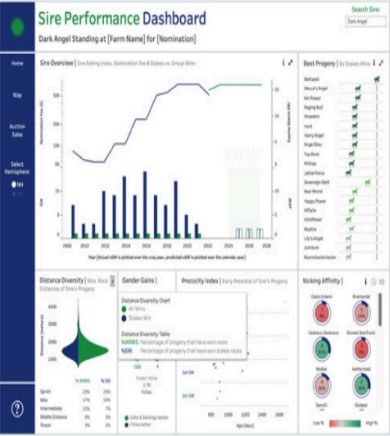
BELOW: Equine Match’s Sire Performance Dashboard: Advanced bloodstock analytics linking offspring achievement to breeding potential.
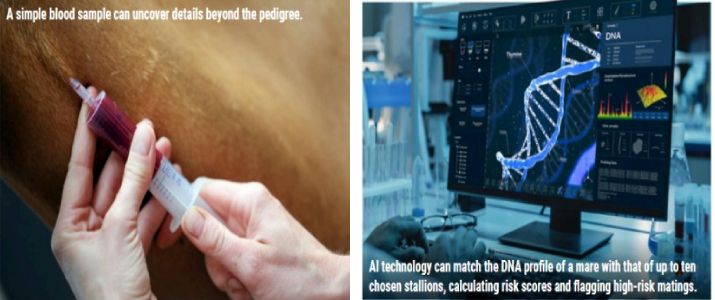
A simple blood sample can uncover details beyond the pedigree.
Al technology can match the DNA profile of a mare with that of up to ten chosen stallions, calculating risk scores and flagging high-risk matings.
One leading example is Checkmate, a revolutionary online breeding tool powered by Equinome. Checkmate enables breeders to analyse their mare’s genetic profile in high definition and identify stallions that best complement her DNA, all from a simple blood sample that uncovers details beyond the pedigree.
Checkmate empowers breeders and stallion owners to manage genetic inbreeding risks, increasing the chances of live foals and enhancing racing durability. Scientific studies have shown that higher levels of genomic inbreeding are linked to severe issues such as foal loss, stillbirths and decreased racing potential.
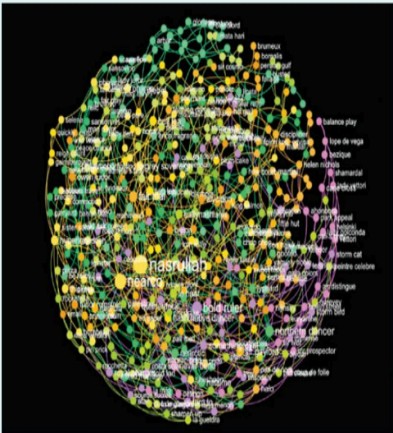
BELOW: Equine Match’s Genetic Galaxy: Visualising nine generations of thoroughbred lineage.
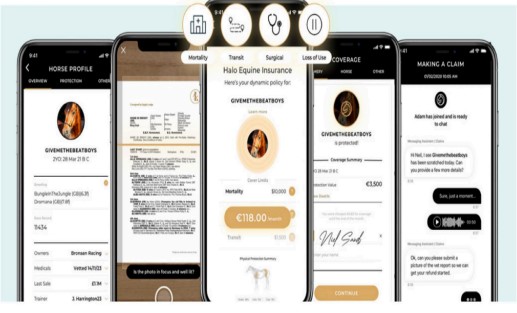
ABOVE: The Halo app aims to offer advanced analytics to members of the horse industry and features its Al assistant “Hailey,” designed to guide buyers through the complexities of sales selection.
Research from the Royal Veterinary College and University College Dublin has highlighted the significant impact of inbreeding on foal viability and racing success, underscoring the importance of managing these risks. Checkmate provides real- time predictions of genomic inbreeding in hypothetical foals by matching the DNA profile of a mare with that of up to ten chosen stallions, calculating risk scores and flagging high-risk matings. Checkmate helps breeders avoid high-risk genetic combinations that could lead to foal loss, thereby allowing them to make more informed breeding decisions. By leveraging genomic data, breeders can refine their breeding strategies, enhancing the health and durability of their foals and pushing the limits of what is achievable in Thoroughbred breeding.
The advent of these advanced tools represents a significant shift in the breeding landscape. As Luca Cumani, breeder at Fittocks Stud, notes, “This will be a progressive change to refine choices, and it will always need to be paired with human observation, but it’s important to be open to understanding how these new technologies work.”
▸ At the Sales
During the Sales, the phrase “good luck” is often exchanged, reflecting the hope of finding and securing the best horse, a potential future champion, from the lengthy catalogues.
But is success really just about luck, or is there a way to minimise this element and base our decisions on more objective criteria? Recently, a range of advanced tools have been developed to support bloodstock agents, trainers, and owners in their search, using Al-based systems that draw from extensive databases to inform better decision-making. There are various methods to approach these objective analyses, including pedigree evaluations, biomechanical assessments.
For example, a significant advancement in this field is Halo, featuring its Al assistant “Hailey,” designed to guide buyers through the complexities of sales selection. Hailey analyses detailed data on each horse, from performance history and pedigree to biomechanical evaluations.
What truly sets Halo apart is its partnership with the most advanced Vet-Al on the market, that contributes to providing a record of the health of the horses that will be purchased. This partnership enables Hailey to deliver a detailed health record of the horse being considered, interpreting complex veterinary reports such as X-rays with remarkable accuracy and predicting potential health issues.
Also, Equine Match helps users refine their shortlists by analysing pedigree quality, racing performance of progeny, and detailed sire ratings, to provide an objective assessment of each horse’s potential. This approach enables users to manage and compare a large volume of data in a short time, far beyond what the human mind could achieve, enhancing the overall selection process with precise, data-backed insights.
Another interesting tool is Tom Wilson’s biomechanical profiling technique, which evaluates a horse’s physical structure and movement patterns to gauge its racing potential. Wilson has extensively studied the link between biomechanics, kinematics and on-track performance. His approach involves collecting detailed data on every yearling sold at auctions in major markets like the UK, Ireland, France, the US, Australia and New Zealand. Key measurements include joint angles, the speed and velocity of specific body parts, the coordination between joints, and the cycles and rotations of their gait. By analysing this information from a growing database of 6,000 yearlings, Wilson identifies the biomechanical traits that correlate most strongly with racing ability. This data-driven approach allows comparisons between a horse’s biomechanical profile and its subsequent performance on the track, highlighting the most critical joint movements that influence future success.
The use of Al and data-driven tools represents a different approach from the traditional methods of horse selection, striking a delicate balance between technology and intuition. As breeder Franca Vittadini notes,
“AI will never help me feel the sensation a horse gives me when I look at it, or see the small flaws and qualities that make me think it’s the right one.”
Yet, there is also recognition of the need for more objective strategies. As Spencer Chapman, co-founder of Equine Match, states, “we’ve got to find a more scientific way to select.” This blend of traditional expertise and modern technology is reshaping how the industry identifies and invests in future champions.